In the unique and challenging environment of Saudi Arabia, understanding the most dangerous types of cracks in Saudi Buildings is not just a matter of property maintenance, it is a critical safety imperative.
From the corrosive humidity of the coastal cities to the expansive soils inland, local structures face specific threats that can lead to catastrophic failure if ignored. This guide will walk you through the identification, causes, and solutions for these structural red flags.
Importance of Identifying the Most Dangerous Types of Cracks in Buildings
Identifying structural cracks early is the cornerstone of building safety and asset preservation in the Kingdom. With the rapid urbanization aligned with Saudi Vision 2030, maintaining the integrity of existing infrastructure is as vital as new construction. Dangerous cracks compromise a building's load-bearing capacity, making it vulnerable to collapse under stress. Furthermore, they allow moisture and chemicals to penetrate, accelerating the deterioration of steel reinforcement through corrosion, a primary cause of concrete decay in the region. Early identification can mean the difference between a simple epoxy injection and a multi-million riyal structural rehabilitation.
Common Causes of Most Dangerous Types of Cracks
The Saudi environment presents a perfect storm of factors that lead to severe cracking. Understanding these causes is the first step in prevention.
- Along the Gulf coast, chloride attack from high humidity and saline air is rampant. As steel reinforcement rusts, it expands and exerts immense internal pressure on the concrete, causing it to crack and spall . Research in Tabuk indicates that a significant portion of building cracks are attributed to this phenomenon .
- The extreme temperature swings between day and night in the desert cause continuous expansion and contraction of building materials, leading to stress fractures. This is compounded by the extreme heat, which can dry and shrink concrete too rapidly.
- In areas like Najran and Abha, buildings are at risk from ground instability. Factors such as groundwater withdrawal, soil collapse, and even pre-existing fault lines can cause massive earth fissures that tear buildings apart from the foundation up .
Difference Between Minor Cracks and Most Dangerous Types of Cracks
Not every crack is a reason to panic, but distinguishing between superficial damage and structural danger requires keen observation.
Minor Cracks (e.g., hairline cracks, crazing, fine plaster cracks) are usually cosmetic. They are typically less than 1-2mm wide and are often caused by surface shrinkage or minor settlement. These do not affect the structural integrity of the building.
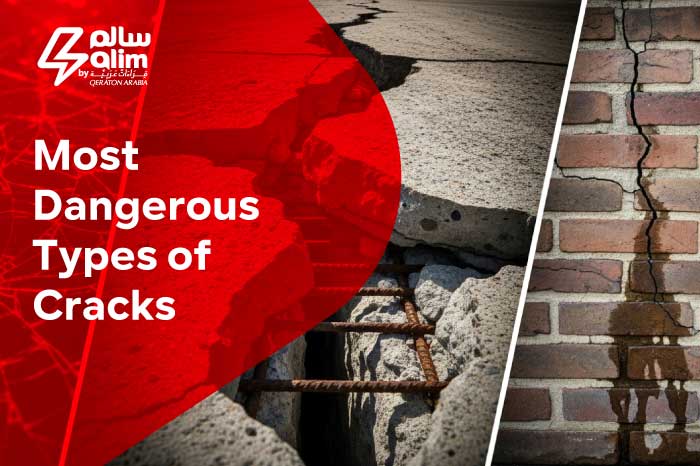
Most Dangerous Types of Cracks are those that indicate movement or failure of the structure itself. These include:
- Structural Cracks: Often found in load-bearing walls, beams, or columns.
- Shear Cracks: Diagonal cracks, usually near supports, indicating severe stress.
- Corrosion Cracks: Rust stains accompanying cracks, signaling internal reinforcement decay .
- Active/Fissuring Cracks: Cracks that widen over time, often linked to ground movement .
Best Methods to Detect Most Dangerous Types of Cracks Early
Modern technology allows engineers in Saudi Arabia to move beyond guesswork. Early detection saves lives and money.
- Ground Penetrating Radar (GPR): As used in studies on the Abha dam, GPR provides a non-invasive scan of concrete, revealing internal fractures, voids, and the condition of steel reinforcement without breaking the surface .
- Advanced NDT Technologies: For high-stakes infrastructure, techniques like Phased Array Ultrasonic Testing (PAUT) and Time-of-Flight Diffraction (TOFD) can accurately map the depth and severity of cracks, detecting issues like stress corrosion cracking before they become visible .
- Regular Structural Audits: Accredited engineering offices in Riyadh and other cities emphasize the importance of regular visual inspections by certified professionals to map and monitor cracks over time .
Steps to Repair Most Dangerous Types of Cracks Professionally
Once a serious crack is identified, professional intervention is required. The repair process is methodical and engineered for long-term results .
- Engineers must first determine the root cause—be it corrosion, overload, or ground movement.
- Damaged and spalled concrete is removed, and the reinforcement is cleaned and treated with anti-corrosion coatings.
- For structural integrity, epoxy injection is the gold standard. Studies have shown that the flexural strength of epoxy-repaired samples can actually exceed that of the original, undamaged concrete .
- In severe cases, advanced composite systems like carbon fiber reinforcement are used to restore or even enhance the original load-bearing capacity .
- Finally, protective coatings and waterproofing systems are applied to prevent future ingress of water and chemicals .
When to Consult an Expert for Most Dangerous Types of Cracks
You should contact an accredited structural engineer immediately if you observe:
- Cracks wider than 5mm (approximately ¼ inch).
- Cracks that are diagonal and run through load-bearing walls.
- Visible rust stains seeping from cracks.
- Floors that are sloping or uneven.
- Doors and windows that suddenly stick due to frame distortion.
- Cracks that grow rapidly over a short period.
In cities like Riyadh, where urban expansion is massive, consulting an accredited office ensures compliance with local regulations and international safety standards .
Cost of Repairing Most Dangerous Types of Cracks and Influencing Factors
The cost of repairing serious structural damage in Saudi Arabia is highly variable. Minor epoxy injection for a few cracks might cost a few thousand riyals, but major structural rehabilitation involving carbon fiber wrapping or foundation underpinning can run into hundreds of thousands.
Key influencing factors include:
- Corrosion damage requiring concrete replacement is more expensive than simple crack injection
- Cracks in difficult-to-reach areas (high-rise facades, foundations) require more complex safety and access equipment.
- If the crack is caused by ongoing ground settlement, simply filling the crack is useless; the foundation must be stabilized first, which is a major cost factor.
- Using advanced composites or specialized injection resins costs more than traditional mortars but offers a longer lifespan .
FAQs
What are the main causes of Most Dangerous Types of Cracks?
In Saudi Arabia, the primary causes are reinforcement corrosion due to chloride attack in coastal areas, extreme thermal expansion and contraction, and geotechnical issues like earth fissuring or soil collapse
Can Most Dangerous Types of Cracks be repaired without major construction work?
Yes, depending on the cause. If the structure is stable and the issue is isolated, techniques like epoxy injection and carbon fiber strengthening can repair cracks without full-scale demolition . However, if the foundation is compromised, major work is unavoidable.
When do Most Dangerous Types of Cracks indicate serious structural issues?
They indicate serious issues when they are accompanied by rust stains, are wider than 5mm, propagate in a diagonal direction through structural elements, or are associated with visible distortion in the building's geometry (like sloping floors)